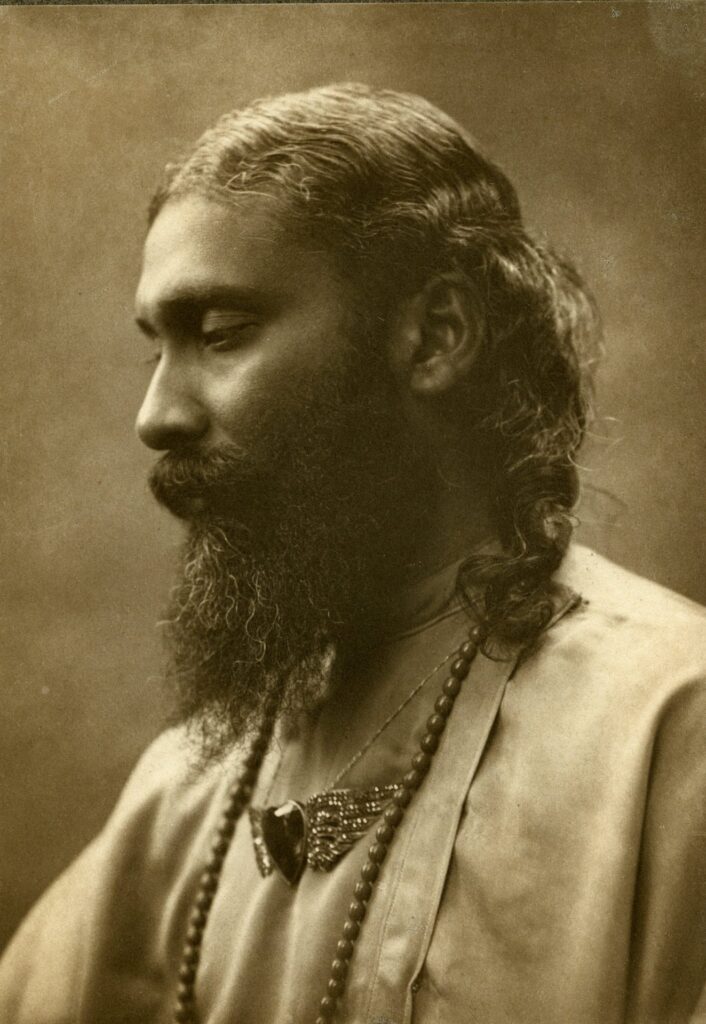
Hazrat Inayat Khan was born in Baroda on 5 July 1882, into a family of musicians. His grandfather, Moula Baksh, was among the most celebrated musicians of his time, and had founded Gayanshala, the academy that would later become the Baroda University Faculty of Music. Inayat Khan showed his gift early — singing before the Maharaja’s court at nine, publishing his first book on music at fourteen, and becoming a full professor at Gayanshala before he was twenty.
It was through music that his spiritual search began. In Hyderabad, where he had gone to carry his grandfather’s musical tradition forward, he met the teacher who would change the direction of his life: Sayyed Muhammad Abu Hashim Madani, a Pir of the Chishti Order. For four years, until his teacher’s death in 1908, Inayat Khan remained his disciple — the years in which the musician became a mystic.
On 13 September 1910, he left India for the West, carrying a charge from his teacher: to harmonise East and West through music. What followed was sixteen years across the United States and Europe — lecturing, teaching, and gradually building what became the Sufi Order and, later, the Sufi Movement. In 1912 he married Ora Ray Baker, who became Amina Begum; together they had four children. From 1921, he held annual Summer Schools — first near Paris, then in Holland, then at his home in Suresnes — where the fullest expression of his teaching took shape.
In October 1926, Hazrat Inayat Khan returned to India. Early in 1927 he travelled to Ajmer to visit the shrine of Khwaja Mu’inuddin Chishti, where he fell ill. He died in Delhi on 5 February 1927, at the age of forty-four.
“My music is my thought, and my thought is my emotion. The deeper I dive into the ocean of feeling, the more beautiful are the pearls I bring forth in the form of melodies.” — Hazrat Inayat Khan